Ward Krancel
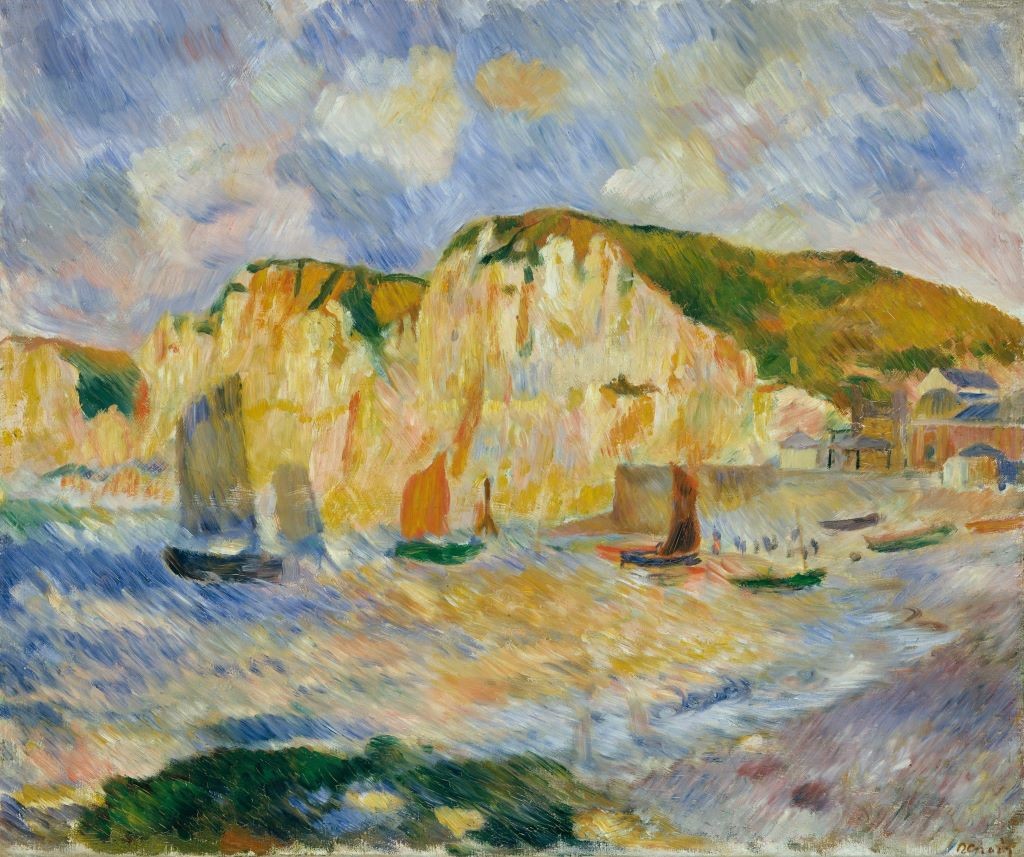
Nearly as tall as Mae, beachgrass covered the dunes but left hollows and openings good for hiding. Looping and dodging like paper kites, gulls wheeled above her, absorbed in endless squabbles. Steady as a heartbeat, surf pulsed against the shore, lulling her eyelids closed. But her arms were getting hot and the top of her head, too, so she emerged from the stalks and ran to the waves. Wet sand squishing between her toes, Mae saw something glimmer, a pebble, partly clear with whorls of blue and green. It bounced along in her pocket as she ran home.
Out the window a row of white pillars, the only clouds in sight, floated in stately procession. A year ago, sitting at her loom, Lana watched a black wall creep over the horizon. At night sometimes in sleep, she again saw a single boat washed ashore, half full of water but otherwise empty.
Mae carefully lifted the latch on the garden gate, trying to sneak in unnoticed, but it squeaked anyway. “Wash yourself,” her mother called through the open window, “and we’ll go shopping.”
Near the rain barrel, a basin sat upside‑down on a shelf. Mae filled it, splashing her face and rubbing her hands with tepid water. Remembering the stone, she plopped it in. Resting on the bottom, it reflected light, making the bowl appear deeper than it really was. Retrieving the pebble and putting it back in the pocket of her dress, she dumped her bath onto a row of onions and ran around to the front of the house.
Mother and daughter walked and skipped, respectively, toward the village center, trees and house walls shading the path, the earth cool on their feet. When they stepped onto the warm, purplish slates of the market, a lumpy shadow rose from a doorway, waving an arm and calling out, “What luck! I was just about to have a snack, and here you are.”
Letting go her mother’s hand, Mae ran to Miko. “You’ve brought something with you, Lana. I’m almost as excited as this one,” he said, inclining his head toward the girl. “Maybe there’ll even be time for a story.” Mae jumped up and down.
Lana sat on a bench against the wall, shoulder bag beside her, and Mae settled onto the floor at her mother’s feet. After serving sweet biscuits and cool tea, Miko retook his stool and said, “Perhaps I should get that story out of the way.” Over the rim of her cup, Mae bobbed her head in agreement.
“What do you have in your pocket?” the old man asked the girl.
“How did you know?” she replied with big eyes.
“You always have something in your pocket,” Miko chuckled, winking to Lana. The girl put the smooth stone into his calloused hand. “Well, what do you know?” he said softly, scrutinizing it.
“The last time I saw one of these, I wasn’t much older than you are now. My grandmother called them Sea Eggs. She said the eagles that live beside the great lake fly over the water and lay them in the air. She told me when she was a girl she’d sit and watch the birds climb high. Two would break away from the rest, clenching their talons together, spiraling until they almost hit the surface. Before flying off, the female would lay an egg as sacrifice to the lake for the food it gave them. It would be transformed into one of these pretty gems, made part from sky and part from water.
“The fish the eagles fed on hoarded them at the bottom of the lake, but occasionally a storm would wash one onto shore. She said if you found it, a spirit would visit, bringing visions of importance.” Mae sat transfixed, nibbling her biscuit.
“When I was a young man—you won’t be able to imagine this—” The girl’s hand darted out and pinched his big toe, protruding from its sandal. “Oow! I’ve been stung by a scorpion,” Miko shouted and sprang up, bouncing on one foot, surprisingly limber and absurd for a man of his years. Lana had stifled her laughter by the time the old man reseated himself. It took a bit longer for Mae to contain her giggles.
“As I was saying, I’d set out to explore the world and make my fortune.” Miko sat straighter, as though looking into the distance. “I was days farther along the lakeshore than I’d ever been before when I came to the mouth of a river. Spring meltwater rushed from the hills, blocking my progress. I dismounted to get a drink and fill my flask. On the sand where I knelt, an egg‑shaped pebble seemed to swirl inside like the torrent rushing by. Remembering my grandmother’s words, I put it in my purse.
“My horse and I camped on the beach, where river met lake. I built a fire of driftwood and fell asleep on the sand, but in the night I awoke, the flames blazing. A strange figure stood across from me, streaked by dancing firelight, its body encased in barnacles like a suit of armor, its long hair twined in coils standing straight in the air. It was a tangie, a demon that lives in water.
“A strange voice reverberated as though from out the bottom of a well. ‘Why do you leave your home?’ it asked. I could barely speak for fear, but I answered, ‘I want to find gold and adventure.’ The demon pointed a long, bony finger toward the horizon.” Miko stretched his arm in pantomime. “‘And so you will,’ it said.
“In the morning I decided it had all been a dream. The flood had fallen, and I forded the river and rode north to the capitol. I sold my horse and found passage on a riverboat, and then a sailing ship, and since then I have seen a good part of the world.” With that the old merchant returned the agate to the girl’s upheld palm.
“Now let’s see what’s in your satchel, Lana.” She reached into her bag and removed a role of tightly woven fabric, unspooling the end into light coming through the doorway, revealing a pale field crossed by dark bands and bright yellow rings. “Ha! Now I have gold, too, so the tangie told the truth.”
Merchant and weaver exchanged coin for bolt, fulfilling their bargain. Mother and daughter walked and hopped, respectively, back to the grove overlooking the sea, Mae thinking of visions hiding in her pocket.
#
Dirty chunks of ice cluttered the tideline, pushed up by heavy surf. Redonning the hood of her cloak, Mae made her way through the naked grove. She entered the main room of the house, fire pit at its center, Lana winding thread onto her spindle. A kettle hung suspended above the coals, and Mae poured herself a cup. “It’s still too rough,” she said, taking a cautious sip.
“You already knew that,” her mother teased, fine fibers twisting through her fingers.
“Would you like tea?”
“I had some earlier.” Mae stretched her hands over the embers as Lana coaxed thread onto the wheel. “After your meeting, will you check at the market for new dye?”
Wind beat the shutters, sneaking through cracks in the walls and blowing ash around the fire pit. Mae put her boots back on, and when she opened the door it almost slipped from her hand. Managing to latch it again, she hunched her shoulders and started down the lane. A white flake landed on her nose, thawing almost instantly. Others soon joined it, motes swirling in the air but not yet accumulating on the ground.
Fishermen at the tavern all agreed, they couldn’t venture out today even if their quarry did arrive. Mae left them by the fire, debating old arguments and telling well‑worn jokes, and headed across the square to Miko’s shop.
“Grandfather, let me crawl into your stove, and I’ll hold the kettle with my mittens.” She crossed the room and kissed his bare head, smooth as a wave‑tumbled rock. Miko sat at a table laid out with delicate chisels and rasps, an ivory tusk held between his knees. It was no longer simply a seal’s tooth, but a serpent menacing a boat, a slender craft with a high prow.
Waiting for his eyes to refocus, the old man said, “Where I was born, they carve in soft stone and it’s never this cold. But the monsters there are bigger and hungrier, so I’m satisfied.”
Miko placed the tusk on the table, levered himself up, and with a hand on his back, shuffled over to the stove. He returned with two steaming mugs, a shallow dish perched atop one of them. “Rare cashews and a hot drink to thaw you,” he said, pouring a few warm kernels into her palm. “What else can this poor peddler provide?”
“Mother wants foreign dyes.”
“I expect an associate of mine soon who might be of aid. He and his pony are probably at an inn on the far side of the mountain, hiding from the wind. To cover the shame of a merchant without wares, will you accept a story in their place?”
Pursing her lips and blowing across the cider, Mae nodded assent, their custom observed unnumbered times since her childhood.
“Last night I dreamed I was an auk,” started the old man, “soaring over the ocean. I saw a fish, swooped, and caught it. When I climbed back into the air, it got bigger and bigger and dragged me down. I flapped my wings as hard as I could, but I went under. The fish changed and became a sea dragon, like the one I’m carving here,” he said, indicating the ivory on the table. “Its tail curled around me, and its claws tore at me, but I didn’t let go.
“If still a bird I would surely have drowned, but I transformed into an ink‑fish, swimming around the dragon and grabbing its tail with my beak. It flailed and bucked but couldn’t throw me. When it tired I let go my bite but kept ahold with my tentacles. ‘Give me a gift worth your life,’ I said, ‘or I won’t release you.’ It held out its scaly claw, revealing a Sea Egg, like the one you found when you were a girl. I took the stone and let the dragon swim away.”
Shadows filled the lane as Mae made her way home. The wind had fallen, no longer pulling her hand as she opened the front door.
“Did Miko have any new dyes?” Lana called.
“No, but he gave me this as I left.” Mae carried a bundle over to the fire and unwrapped it. From a large glass jar it seemed many eyes peered out, entwined in loops of rope.
“Pickled eggs and octopus! I’ll get the pot.”
#
First light stinging her eyes, Mae spotted a thread of black smoke climb from the lookout hut on the headland. Up the beach, men readied oars. Standing and waving, she shouted, “I’m off!” and slid her skiff down the pebbles to the water’s edge.
Salty spray on her lips, she tacked into the wind. Clearing the protection of land, a gust pitched the boat, and she brought the rudder over and ducked under the boom, the sail coming around with a snap. Downwind, geysers of mist sparkled in the sunrise.
With steady strokes, harpoon boats advanced across the bay.
A dozen black forms surged and dipped as Mae drew nearer, timing her maneuver then darting across their path, the pod’s rhythm hesitating. She shifted her weight, preparing to bring the skiff around for another pass. As the sail came over, an arching back rose a few lengths ahead, an animal she hadn’t seen, separate from the group. With a force like falling from high in a tree, Mae struck icy water.
Choking and sputtering, she managed to come up for breath. A twisted horn glanced her shoulder, and she thrust out her arms, hands bumping the creature’s head and slipping along its flank. Like the claw of a giant crab, something clamped Mae’s waist, pulling her below.
Snared by rigging torn from the mast, and she held with it, the great beast dived, thrashing its powerful body to be loose of the tangle but only knotting the line tighter. Plunging deeper, light receding, the last bit of air squeezed from Mae’s lungs, bubbles of her own breath floating skyward, shot through with color. In her dimming mind, a thought caught spark, a vision of importance.
Face against the whale’s back, Mae felt the broad pucker of its blowhole under her hand. She began pounding, trying to work her fingers into the passage, the only place in all this water where there was air. A blast struck her face, but it was gone before she could react. Again beating the huge animal, she put her lips to the hole in a strange kiss. Another rush pushed her away, but at the last moment, she forced her mouth back against the opening and stole a gulp.
Shocked by numbing cold, one small breath won from the crushing sea, Mae was almost drowned. But the whale also foundered, and it began to rise.
Up with the bubbles. Up to air. Up.
They broke the surface together, leviathan and young woman both gasping. Sighting past the whale’s spiral horn—they’d come far into the bay—Mae finally lost consciousness.
#
Dawn peeking around the shutters, Mae squeezed her eyelids tight. What could one more day hiding beneath warm blankets hurt? But then a smell tickled her nose—soup?—and a growl in her stomach drove her from the covers. Perched at the side of the pallet, she pulled up her nightshirt. Deep purple bands crisscrossed her ribs, each breath accompanied by a twinge of pain but each one wonderful.
The pot held seared whale meat and kelp in ginger broth, and after a bowl of it and a cup of hot tea, she felt like getting out of the house. Her mother wasn’t home, so Mae dressed and went into town. A thick gray quilt hung low over the village, fine ice crystals crunching softly underfoot.
“So what’s on the bottom of our little bay?” Miko chuckled as Mae entered the shop. She made a show of kicking his shin, but her boot only gave a tap. The old trader was at work on a new carving—not the horn of the whale Mae had ridden. Miko had convinced the villagers to spare it for delivering her from the waves. After cutting loose the ropes, they tended the animal until the tide lifted it back into the foam.
The tusk the old man shaped showed a figure astride a fat unicorn. “Did you ever hear of the beggar who tamed a rhinoceros?” he asked.
“No, Miko. What’s a rhinoceros?”
Mae sat down near the stove, the first real snow of winter beginning to fall outside.