Ward Krancel
Prologue
Magic? I have a little, say to conceal my door where no one will find it. Sorcery, pacts with the devil? I don’t know anything about that. I don’t know if that sort of magic even exists. Some plants make spells inside themselves that can be used, distinct from medicine or poison. Animals have some. I knew a hare who could bewilder a person just long enough to run off—rabbit’s feet really are lucky, but mostly when they’re attached to the rabbit. But the kind I know is simple stuff that could never hurt anyone.
There’s one race, however, whose magic is different. It’s said they were there at the beginning, but I’m not that old, so I don’t know if that’s true. Memory of their power is so tightly woven into legend they’re synonymous with magic itself. Their deeds have sometimes earned them the name goblin, but most people would say fairy or elf.
It’s possible you’ve run into one, but you’d never know it. You’d just pat your pocket, and your wallet would be gone, or you’d cut your foot on broken glass at the beach. There might be elves nearby having a laugh at your expense. I’d move over to the other side of the street if I saw one coming.
Who am I? Some call us ogres, but that’s considered impolite. There’s a scientific name, but it only tells half the story. I’m a troll; I come from a long line of trolls. But what’s a troll doing walking around? Isn’t that all make‑believe? I hate to be the one to burst your bubble.
What’s a troll then? What does the word troll even mean? My family roots go back to a part of Italy and Austria, up in the Alps. Maybe there’s a connection: Tyrolean, Tyrol, troll. In Old Norse it means magic, so maybe that’s it. But it might as well be French, meaning to wander, for we’re far‑flung now, when you can find any of us at all. My grandmother used to tell me troll meant handsome, but you can’t always trust your grandmother.
My ancestors are trolls from the mountains, but I’m not a mountain troll. There is such a thing—I met one once—though I’m not sure why they’re called that. He was tall, but I wouldn’t have said he was mountainous. Do they live there? I don’t think so. The one I met was at a bus stop. I have a friend who says they got the name after one forgot to flush the toilet, but I wouldn’t repeat that sort of thing.
So I’m a troll. What do I do, hide under bridges and scare people? Nonsense. I mind my own business. That’s what trolls do, mind their own business.
#
Outside the classroom window, rain collected in puddles. Recess was canceled, or rather his class had the choice of going to the library or staying in the lunchroom an extra half hour. Jonathan had a book report to do, so he went to the library. 700 is Art; 600 Technology. 500 is Science; 400 Language. 300 is— Jonathan chose a 300 book and went to a study carrel to read.
#
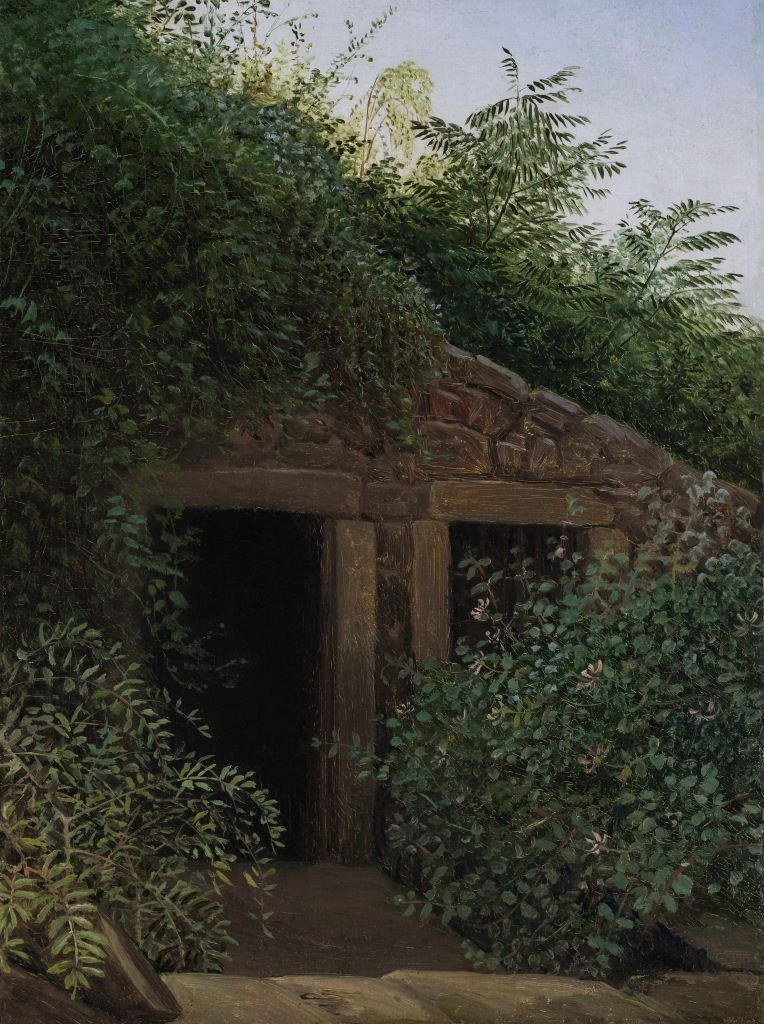
If you stumbled upon a narrow, winding trail diverging from the main path—and you weren’t likely to—you’d pass beside train tracks atop a steep bank. If you stayed on this trail—which you weren’t likely to—you’d eventually come to a door built into the berm. If you were to take a closer look at this door—unlikely as that was—it would appear to be some sort of access to things long forgotten and out of use. But if you looked with a troll’s eyes, you’d see home.
It had been raining most of the day, so when it stopped Omer went for a walk. He was feeling cooped up, and a stretch of the legs always made things better. After exiting the front door, he locked it and, taking a moment to concentrate, hid it. Approaching the main walking path, a sound caught his attention, and he stopped, holding motionless.
Omer carefully retraced his steps. Kneeling beside the stump of a fallen tree, he spotted them across the pond, three or four darker shadows in the gloom among the bushes. Although hard to make out, he knew what they were. It had been a very long time since he’d encountered an elf, but not nearly long enough. Should he go home and risk exposing his door? Should he flee into the woods? It’s true a troll may hide himself from the eyes of most, but these were not ordinary folk.
Then Omer heard something else. Feet crunching gravel, a boy approached on the main path, hands in his pockets. Nearing the elves’ bush, he slipped. Despite the rain, the path was wide and well maintained and should have provided good footing, but the boy pitched headlong down the grassy slope, splashing into the water.
A succession of ponds and small lakes rim the troll’s home, part of a flood control system maintained by the county, paths used by dog walkers and hikers circling them. Culverts connect the pools, with metal gates, lowered and raised as needed. At the bottom end of the drainage, the stream confronts the bank of the train tracks and must pass under, an arch of reddish sandstone blocks forming the aperture. A heavy grate helps prevent it from being clogged by beavers with branches. It’s also designed to prevent someone from getting pulled in.
Spring runoff rushed through the system, pushing the boy against the grate. He struggled, disappearing below the surface before bobbing up and grasping ahold. A troll avoids trouble, but not when someone is drowning. Omer leapt up, scrambled down the slope, and plunged into shocking cold. He swam as hard as he could, and soon the torrent pressed him against the grate, too, pummeling them both. But a troll, though he may be shy, is strong.
Omer gripped the boy’s coat, working them both over to the edge and reaching around the lip of the arch, feeling for something to hold. His fingers found a seem in the stonework, and he got them onto land. Gathering the boy—limp but breathing—under his arm, he crawled up the bank. The elves would’ve been watching. Omer hoped this gave him an advantage. After all, they might not have seen a troll in as long as he hadn’t seen one of them.
At the top of the bank, he stopped—no sound besides the current rushing below, no laughter in the bushes. The little folk are cunning, but a troll has his resources too. Omer concentrated and thought it might be difficult to see anything amongst these trees, that even if you did find a troll’s trail, it was winding and easily lost. Picking up the boy, he retreated along a dear path. A bit farther on, the way forked. An elf might think he’d gone straight, because that was what Omer was thinking. But he didn’t.
Beside the county highway, a green box the size of a shopping cart sits on a cement pad. If you unlock the lid and lift it, you gain access to utility cables. If you thought about it just right, there was another pad, farther from the road, with steel doors lying flat to the ground. These doors had once served the same purpose as the green box, before newer equipment was installed. The work crew hadn’t filled it in as intended. For some reason they forgot all about it.
Unlocking the hatch and lifting the handles, Omer heaved the unconscious boy onto his shoulder and descended the steps of his back door. What was he to do? It wasn’t smart to pick a fight with the little folk. They were dangerous and never forgot a challenge. And what was he supposed to do with a human child, maybe injured, maybe charmed? Well, he knew what to do about wet and cold.
Omer lay the boy near the stove, wrapping him in a blanket, and went to the kitchen to heat the kettle. Returning to the parlor, he found the boy still asleep—or something else. In the front hallway, he listened, wondering if anyone lurked beyond the door. The kettle commenced whistling, interrupting his thoughts.
The boy was sitting up now. “Do you like cocoa?”
“Yes,” Jonathan said groggily.
He set down the mugs and helped the boy into a chair. “Let me have your coat.” Omer hung it on a hook beside the stove and stuffed the blanket tighter around the boy. “Take off those shoes.” After going away for a minute, he knelt and replaced the boy’s socks with dry ones. “Scoot closer to the stove.”
They both sat quietly, sipping hot chocolate. The boy finally asked, “Where am I? What happened?”
“Do you remember anything? Do you remember me?”
“I remember you helped me get away.”
“I was trying to get away myself,” Omer chuckled. “What’s your name?” Jonathan told him. “People call me Omer. It’s really Omerastus, so just Omer. I’m sorry, Jonathan, but we’re in a pickle. The thing is, there’s someone you might not know, but now they know you—”
“I want to go home,” Jonathan interrupted.
“Of course you do.” Omer decided they might as well risk the walk through the darkening woods. “What’s your address? Just follow me, and you’ll be home in no time.”
“Yes, sir.”
“It’s not sir, it’s Omer.”
A steep footpath crossed the train tracks. “Careful, it’s muddy.” Omer guided Jonathon by the elbow, up and over. A bike path through the park led to an open stretch of lawn; the boy was slowing. “Let’s sit for a minute.” On a bench beside the trail, the boy fell asleep again, closing his arms around the troll’s neck as Omer picked him up.
Reaching Maple Street, Omer set Jonathan on his feet. “I don’t think I should come with you to the door. You’re late, and I’m sure everyone is worried.” Reaching into his coat, he handed something to the boy. “This belonged to a friend of mine, and he left it to me in his will. It might help with explanations.”
Jonathan hesitated. “What if I need to find you?”
“Oh, I’m sorry. Here’s my phone number.”
“You have a phone?”
“Sure, don’t most people?”
On the lighted porch of his house, Jonathan opened the door, stepped inside, and started up the stairs.
“Jonathan is that you?” his mother called. “Where have you been?”
“I was at school,” he said without thinking.
She leaned her head out of the kitchen. “What were you doing?”
“Writing a book report.”
“What about?”
“Pa·le·o·an·thro·pol·o·gy,” he pronounced syllable by syllable, a word from the title of the book he’d been reading in the library.
“What’s that?”
“The study of old people.”
“You mean ger·on·tol·o·gy.” Jonathan began saying his word again but stopped. She’d gotten him. Scowling ruefully, he climbed the stairs. “Wash up. Supper’s almost ready.”
When he got to his room, Jonathan sat on the bed. His clothes were still damp, so he put on his pajamas. While undressing he felt a bulge in his shirt pocket, and remembering Omer giving him something, reached in and pulled out a fuzzy rabbit’s foot key chain.
#
At mid‑afternoon Omer walked over to the park abutting the school grounds. He seated himself at one of the tables, extracting a sandwich and an apple from his bag. Orange buses lined the curb, and parents waited in cars. Bells rang in the building and children streamed out the doors. Nothing seemed out of place. He didn’t sense the elves anywhere nearby, but that didn’t prove they were gone.
A child detached itself from the mass of excited youngsters and walked up the path to the picnic pavilion. “Hrrrowtherrr,” Omer said, munching his sandwich.
“I remember better what happened, but maybe not all of it.” Jonathan joined him on the cement bench. “I was walking, and I fell into the water, or maybe somebody pushed me. You pulled me out and brought me to your house and warmed me up. And I guess I got home because I remember being home.” Jonathan seemed to have finished but then asked, “Did someone push me?”
“I don’t think so, but they might have tricked you, made you slip.”
“Who was it? I felt funny before I fell.”
“There was someone else there, but I don’t think they’re around anymore. I’ve been looking. I did see something peculiar, though, about halfway up the trail. Would you like to go see?” The boy tensed up at the suggestion of going back near where it had happened. “You’ll come to no harm if you’re with me.”
Jonathan’s shoulders relaxed, and he stood up and stuck out his hand. “I’m Jonathan.”
The troll also stood. “Yes, I remember, and I’m Omer.”
“Gomer?”
“Omer.”
“Homer?”
The troll started to say his name again but stopped, a broad smile spreading across his broad face. “You got me.”
They shook on it, the boy grinning proudly.
“Are you hungry?” Omer asked, splitting the apple in two with his pen knife. After trimming the ends and cutting out the core, he handed half to the boy, and they headed toward the ponds. At the point where the highest reservoir empties into the next one in the chain, they encountered a low earthen levee. “Come up slowly. Do you see them?”
Jonathan crept forward. “Yes … fish.” They kneeled at the edge of the pool, the creatures a few yards away.
“They remind me of those giant goldfish.”
“Koi,” Jonathan said.
“Yes, but they’re not. I don’t think I’ve ever seen this kind, and that shouldn’t be true.” In the water ten or fifteen forms—large, delicate fins and rainbow‑hued scales—slowly twirled. “I’m not sure what it means, but our little woods here are turning peculiar.”
They watched the fish swim their dance a while longer, before returning the way they’d come.
With Jonathan close behind, Omer wound his way along the narrow trail beside the train embankment, grasshoppers buzzing in afternoon heat. Stopping near a clump of brambles, he produced a key from his pocket and unlocked a door, now visible amongst the vines. They went inside, Omer flipped on the lights, and Jonathan plopped himself down in an overstuffed armchair.
“Would you like some lemonade?”
“Sure.”
Removing a stoneware jar from the icebox, Omer poured two glasses.
“This tastes different,” Jonathan said. “It’s good, just different.”
“That could be because I squeezed the lemons myself,” Omer responded, squinting and blinking his eyes. “And a bit of advice, If you ever make lemonade from scratch, use goggles.”
Jonathan was enrolled in a summer recreation program, learning kayaking and archery and other outdoor things. He was also entered in a charity reading challenge. But his parents didn’t believe in overscheduling, so he had plenty of free time to play baseball with his friends and putter around the neighborhood. And it had become his habit to visit Omer some afternoons.
They’d gone all the way to the river, walking Jonathan’s dog. On the lawn between the school and the park, he’d shown the troll how to throw a Frisbee only to find out Omer already could do it pretty well. They both tried to throw a boomerang that Jonathan’s father had given him for his birthday that year, but neither of them could get it to come back.
But what Jonathan liked to do best with Omer was nothing. They would have a spot of tea—he’d heard that phrase on a television show—and talk. They mostly stayed away from one subject, but today for some reason Jonathan asked, “Have you seen the elves again?”
“Why would you think there’s any such thing as elves?” Omer replied nonchalantly.
“I was reading, and I think I figured it out.”
“When I was a boy,” Omer said after a moment, “while we were doing things together, my grandmother would tell stories. She raised me, you see. It wasn’t until I was older that I found out we weren’t really related. She showed me a grave on the hill and said my mother had been traveling and had gotten sick. My grandmother told me fairy tales, the sort you’ve heard. She had other stories, more like poems, she said were older. This is one I remember.
Overhead a strange bird flew
First one by one then two by two
New birds came north
Soon filling the sky
Covering the sun
Drinking rivers dry
Landing in the boughs
Birds began to trill
The seeds of this valley are ours now
You may do as you will
“She had lots of stories about elves. Some were scary, though others were funny because the little folk gave a fool his comeuppance. But like my grandmother’s stories, most of the things you read about elves are made up. And no, I haven’t seen them again since we both did this spring.”
Jonathan seemed reassured. Omer, however, was not. Although it’s true that much of what’s in histories and folklore is imagined, some things in books and old stories are true. And he hadn’t told the boy everything.
A circle of mushrooms is called a fairy ring, but it isn’t magic, it’s just how the fungus grows. But perhaps, long ago, it reminded people of strange places in the woods, growing in patterns, the way things grow near the little folk. Most people will never see an elf—it would be like glimpsing an ivory‑billed woodpecker—but they once ordered all nature.
Myth has it the stone rings in Europe mark the entrance to a fairy’s underground kingdom, filled with treasure. This isn’t true, but that story may have begun because some of those places had been built where elves once dwelt, in hope magic lingered. And sometimes, when no one was around, the little folk would reappear. Maybe there was power there, power they knew how to use. Maybe they simply wished to defile.
What concerned Omer most about the old legends was the part where a human child, one the elves had enchanted, was led away from its home, never to be seen again. No one he’d ever heard had a satisfactory explanation for what the elves did. His grandmother claimed to have seen the remains of one of these rites, the butchered bones arranged in a posture more like a dog’s than a human’s, the extra bits used for the tail.
#
As summer progressed, Omer continued to be out and about. He’d always loved a good walk, even if his outings were now more of a patrol than a stroll. When autumn stripped the trees of leaves, he started finding strange things in the woods. Here and there bright greenery persisted long past season. In the field near the road, grass had gathered in intricate swirls—not random as though shaped by the wind, not flattened as someone might do with a board as a prank.
Winter came apace, and a cold snap froze the ponds. A few weeks later, a deep snow fell, sending Omer on a search through his closets, rummaging around until he found his skis. It was quiet in the woods, his tracks the only ones in sight. Though mid‑afternoon, the sun was already beginning to set, staining brushstrokes of high cloud coral pink. But then he felt something odd, a tingle as distinct as an itch.
Omer hurried to the school, shuffling crosswise over the train tracks without removing his skis. At the top of the sledding hill, he detected it again, the charm of elves. At the bottom of the twilight slope, the imprint of a sled headed onto the snow of another frozen pond, several sets of shallow footprints dotted around it, small feet with odd shoes.
He followed the tracks until they reached the road, passing into a large culvert. Omer took off his skis, leaving them there, and on hands and knees, crawled into the black tunnel. On the far side, marks from the sled met the bike path to the river.
Bare branches arch above the floodplain, a cathedral vault of timbers casting a web of shadows on its snowy floor. Fairies formed a circle around Jonathan, tied to a leaning, partially fallen tree, eerie incantations echoing in the cold air. One of them stepped forward, the ring closing behind him. He appeared a handsome child, fine gold wire set with small rubies entwining his hair. Or was it thread strung with winter berries? The elf raised his arm, something bright in his hand.
The chant faltered as the troll came crashing through the darkness. Looking to one another and to the one at the center of the ring, the fairies stood frozen a moment before scattering. Omer untied the boy and gently shook him. “We need to get out of here,” he said, swinging Jonathon up piggyback. But he didn’t turn toward town.
In a few minutes, they came to the riverbank. A figure stood in the middle of the moonlit expanse, the elf who’d been at the center of the circle. Omer propped Jonathan against a tree trunk. “Wait here a minute. I’ll keep an eye on you.”
When he’d been a boy and the nearby lake had frozen over, Omer went skating. As the sun set and the temperature dropped, a sound like a gunshot rang out, the ice cracking. He’d looked all around—no open water; the ice remained in place—but he never forgot that feeling, being forced to remember he was suspended above deadly cold.
Carefully stepping over ridges pushed up by the current, a faint gurgling coming from the river below, Omer approached the motionless figure. When he judged himself near enough, he said. “You lead your people? You’re their king?” No reply was forthcoming. “You should go now. This place is guarded by a troll.”
A piping voice, harsh as a crow’s call, replied, “I don’t know who I hate more, them or you. We were here before grass, before trees, when ferns were trees. When your people showed up, it seemed trivial, but when they appeared it was like the sea coming onto land. Together we might have stopped them. There were enough of us then. Instead, you hid in your caves.”
“That boy never harmed you.”
The elf withdrew a dagger from his belt, a pale glimmer on its thin blade. It’s the little folk’s chance to have power over life, both health and decay. Omer knew the knife was not merely metal that could cut flesh. If it but touched bare skin, it would release a spell of decline.
Luckily, when the fairy launched his blade, Omer wasn’t standing there. The elf spun wildly, questing for his target, slashing the magic knife back and forth through empty air until Omer stepped up from behind and laid his hand on the elf’s slight shoulder. Tired from wasting his power, grieving for a lost world, he collapsed to his knees.
“You may know my kind for our gift to conceal, but perhaps you don’t know our ability also to reveal. If you don’t leave,” the troll said, “I’ll make it so all can see you, so that men will know you. Leave the boy alone, leave this town alone, or I’ll do this.”
He left the little king crying bitter tears onto the ice. Omer couldn’t hate him, there were so few of them left, but neither could he let the elves harm Jonathan or the other children from the school. And maybe, thought the troll, he was in part to blame.
Returning to the riverbank, he again lifted the boy, heading for home. Climbing the bluff fatigue finally hit, but in half an hour they were nearing the house on Maple Street. Omer set Jonathan down and rang the doorbell. He pressed the button again and heard someone approach from within. Before the door opened, holding the handle lightly, he felt a touch on the other side.
“Here we are again.” Jonathan’s father stood with a puzzled look on his face. “The boys were all having fun at the sleepover, but when Jonathan started feeling poorly it seemed the thing to do.”
The father’s look of confusion resolved, replaced by relief. “Thank you so much Mr.—I’m sorry, my memory is so bad.”
“People call me Omer.”
“Better get him off to bed.” Jonathan’s father reached out his hand. “Thanks again, Mr. Omer, for taking care of my son.” They shook hands, the troll letting the error pass.
Where, close beside train tracks, a little trail leaves the main path, Omer paused a moment and unmasked its entrance. Reaching home, he revealed the door set into the bank and left it that way. He’d been thinking, why would elves, the rarest folk in all the world, show up on his doorstep? Had they sensed his own humble magic in these woods? Had he somehow attracted them? Maybe it would be better to try and live without magic for a while. It could be more trouble than it’s worth.
Taking out his key, he slid it into the well‑oiled lock in the rusty iron door. Inside, he banked the coals and added a piece of firewood to the stove. To any who were near enough and looking in the right direction, a faint line of smoke could be seen exiting the top of a hollow tree, rising in the moonlight.