Ward Krancel
Hidden in the forest
A hunter lay in wait
Confident of concealment
With clear view of his bait

Then he saw a strange beast
Coming down the trail
Long nose to the ground
Wagging its tail

Not a fox nor a wolf
But a canine of some kind
It looked directly at him
Crouching in his blind

A second new creature
Down the trail did come
A peculiar man tall and thin
Two hunters facing one
#
For days a thick gray blanket had covered the town, but when Omer opened his front door bright winter light streamed into the entryway. Putting on coat and hat he called, “Sam, let’s go get some sunshine.” From a chair in the sitting room, the cat lifted its head, sniffing air coming in the door.
Seated on a log beside a frozen pond, Omer watched the orange tabby nosing about in the bushes. From a tall cottonwood on the other side, the harsh voice of a crow disturbed the peace, and by ones and twos its comrades joined in, shouting their fight call. Seeing motion, Omer looked up into the branches above his head. Broad, silent wings glided through the trees; the crows had spotted an owl. Black arrows shot across the pond, aimed at their enemy. The clamor continued into the woods, rising and falling before it moved out of earshot.
The clearing was quiet again, and Omer and his cat resumed their relaxation. At the edge of the meadow, a silhouette came into view—snout forward, ears pointed high, trotting an easy, ground‑covering gate. Soon a coyote stood in front of the troll.
“Having an excursion, are we? A little lie about?”
“It’s never the wrong time to make the best of things,” Omer said smiling.
“Well, if you’re not too busy enjoying yourself, would you condescend to join me tonight on a matter relevant to our neighborhood?”
“Of course.”
“Meet me at moonrise, the overlook on the second lake.” The coyote turned toward Sam, seeming just to have noticed him.
“I wouldn’t recommend it. He’s still got his claws.”
“I wouldn’t stoop gastronomically,” the coyote replied before slipping back into the trees, always one for the last word.
“Come along, knucklehead.” Sam got up and followed his master home.
#
Rechecking the clock, Omer left for his rendezvous. In fifteen minutes, he reached a fork in the path, down to a bench overlooking a small snow‑covered lake. Sitting on its haunches, the coyote waited. “I don’t think it will be long.” Omer brushed off the bench and sat down. “I saw it first a week ago, in a swamp near my den, and something’s been bothering me.”
On the far side of the lake, deer began passing by in single file. From somewhere in the woods came a howl, and then another and another. The herd bolted onto the ice, and out of the trees came the dogs, harassing their flanks and nipping at their hooves. But the long‑legged deer had an advantage in the deep snow and increased the distance between themselves and the pack. When they reached the near shore, the dogs were only halfway across, persistent but losing ground.
“I’ve seen it before,” Omer said. “Neighborhood dogs joining up together. Their owners won’t even know they’re doing it.”
“I’m familiar with the phenomenon, but there’s something different here. I smell it.” The dogs were nearing shore. “Time to go,” said the coyote. Omer grunted, lost in thought. “Yes, you chew on that bone.” Hurrying back to the main trail, they went their separate ways.
#
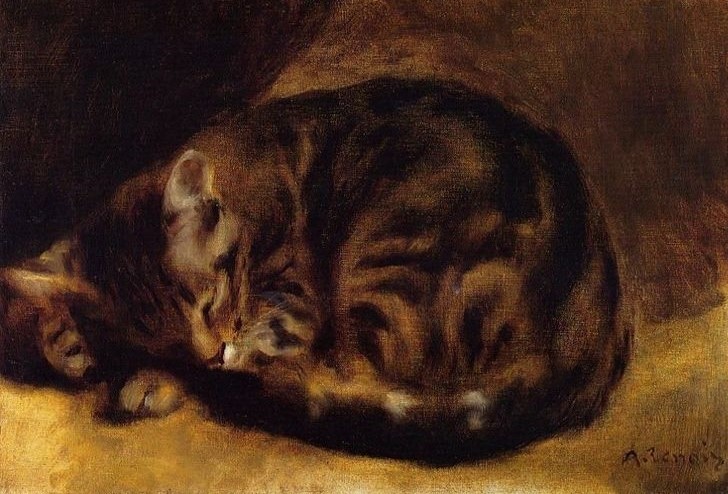
Jonathan had come for a visit, so Omer fixed cocoa. On a table near the stove, atop a placemat, the old cat slumbered. A game board of polished wood sat beside it, smooth pebbles positioned on painted squares. At the center of the board, in a depression carved into its surface, rested a small iron peg. Jonathan heard a scratching sound and looked over to see the peg spinning like a compass needle, pointing to one or another of the markings at the cup’s edge. Next to the board, Sam slept on.
Omer got up, went to the table, and scribbled something onto a notepad.
“What’s that?” Jonathan asked.
“A friend of mine from back home. We’re playing a sort of checkers.” He moved a pebble across the white and yellow squares of the board, scowling. “The fink took half my back row.” Omer reached down and spun the peg in the cup, the cat finally stirring and raising its head.
“Can I?”
“You know where the treats are.”
The boy went to the cupboard, taking a foil pouch from a drawer. On the table Sam sat up, eyes focusing as Jonathan flicked his hand, launching something into the air. In a flash the cat batted the morsel down, pinning it with his paw, apparently wary it might flee.
“My grandmother didn’t think it was good to be alone in the house, so you can blame her,” Omer said somewhat cryptically. The cat looked up, done with his treat. But seeing no more food coming, it settled back down on the table and was asleep again almost at once. Omer absently reached out his hand and scratched Sam between the ears, a soft rumble filling the room.
“What else did your grandmother say about cats?”
“Just that they poop a lot.”
“No, I mean like adventures they had or something.”
“You mean stories she used to tell?” Omer knew when he was being played, but he liked to talk, so he didn’t mind. “I don’t remember any with cats, though she did have a parable about another pet.” Jonathan sat attentively, sipping his cocoa, as Omer recounted the tale of the man who saw a dog for the first time.
When the troll finished his recitation, acting out as many of the characters and actions as he could remember, bending forward and reaching his arm over his back, waving his hand for the dog’s tail, Jonathan said, “What was your grandmother’s name?”
“Mathilde, but everybody called her Tilly.”
“What does the story mean?”
“Hmm … I suppose it depends on whether you’re a cat person or a dog person.”
#
When he met people out walking their dogs, most of them, and most of the dogs, too, were well‑socialized. But after the coyote had shown him the pack chasing deer, Omer thought he noticed a difference in the local canines. He found himself scrutinizing every animal, wondering if this one had been running wild at night. Perhaps he was projecting his own unease, but the dogs seemed nervous.
One day, on a paved path near the picnic grounds, a young couple came along in the opposite direction, walking a mastiff. The man held a leash in his hand, but apparently, it wasn’t latched onto the dog’s collar. When they got near, it charged. Omer crouched reflexively, readying himself to fend off the powerful dog should it try to bite or knock him down. But then something funny happened.
It had snowed recently, and although the trails had been cleared, there were slippery patches. As the dog lunged, barking fiercely, Omer heard nails striking asphalt. But then the sound skipped as she hit a patch of ice and began sliding. Their eyes locked for an instant, and Omer saw the dog had changed her mind about the whole thing. The young man ran forward, grabbing her collar. He and the woman apologized profusely as Omer stood up straight, assured them he was okay, and continued down the path.
Then it happened again. A few days later, another dog broke free from the grip on its leash and charged him. No one got hurt, but his worry only deepened.
#
Omer liked to get coffee freshly roasted at the shop downtown, so he bundled up and went for a walk. Where the bluffside trail met the main road, it passed under a bridge, spray paint decorating the sides of the tunnel. Lime green swoops formed tall, squishy letters. Magenta clouds and tagger’s initials floated above a futuristic cityscape. Omer noticed something he hadn’t seen there before, a scrawling black line of script he didn’t recognize.
At the bottom of the bluff, he entered the town proper. A burst of warm, fragrant air washed over him as he pulled open the door of the coffee shop. Smiling at the pretty woman behind the counter, he ordered a bag of his favorite blend and a cup of hot apple cider, taking it to a seat near the big front window.
Sipping his drink, Omer watched the world on the other side of the glass. It was mid‑morning, not much going on in town. A car rolled slowly by, steam rising from its exhaust pipe. A woman in a puffy coat and checkered hat came down the sidewalk, a little poodle beside her in matching attire, right down to its fur‑lined booties. Across the street the owner of the bowling alley sprinkled salt onto the sidewalk, picking up scoops from a bucket beside the entrance.
On the other side of the glass, a strange fellow walked by. He wore a ratty old jacket, open at the front, with just a t‑shirt underneath. A tumble of black hair spilled out from a baseball cap, his pale skin contrasting with dark beard reaching far up his cheeks. As he sauntered past, the man looked through the window, straight at Omer, his face a cool smirk. Takes all kinds, the troll thought to himself.
The bell above the door rang as Omer exited the coffee shop. He wasn’t hungry yet, so he decided to extend his walk and headed toward the river. A cement stairs climbed the side of the steep bank, and at its top he turned onto a paved bike path. In a few blocks, the levee exited town precincts, downstream into floodplain, sandy forest replacing street and building.
In a mile the main trail left the river as the levee curved inland. A side path split off here, onto an abandoned railroad track, the ties and rails removed. Thickets of willow switches crowded the shore, and beyond them a tree rested on its side like the skeleton of some monster. Torn free from the bank upstream, it had been tumbled in spring floods and stripped of bark, stranded on a sandbar, and bleached white as bone by summer sun. Now it lay trapped in ice, its boughs resembling a giant, hollow rib cage.
Tracks preceded Omer in the fresh snow—the deep‑treaded soles of a hiker, paws and winter boots of dog walker and companion, three sets going out and returning back on the dead‑end trail. The old rail bed ran to where a trestle had once spanned the river but now ended at the water. Beer cans and remnants of campfires showed that teenagers sometimes came out to the spot at night. At the river’s edge, tar blackened pilings formed a short precipice. He paused there a minute, looking across to the matching footing on the opposite shore.
On his way back, Omer noticed tracks crossing the trail, from woods to river. He stopped, wary, but followed them into the brush. One after another bare human footprints weaved between the bushes, ending clustered around a mighty cottonwood trunk laid out like a fallen smokestack. Omer stood still and listened but heard no sound, though something animal lingered in the air. Beneath the huge trunk, in a shallow depression, dirty clothing and rubbish were matted into a bed, empty food containers and plastic bottles strewn about, the animal smell strong.
Omer retraced his steps back to the bike path. When he got to the foot of the bluff, he turned uphill, following the trail home, all the while fighting an urge to take off running.
#
Jonathan plopped down on the bench, and Omer leaned forward, letting Henry sniff his hand and giving him a rub on the noggin. “Who’s up for a game of fetch?” The three walked to the playground, deserted on a Saturday morning, where children had trampled the snow. Omer took a tennis ball from his coat pocket and tossed it. The old, half‑blind dog trotted after the ball, but when he got to where it had stopped, he took a seat and started chewing it. On opposite ends of a nearby teeter‑totter, the boy and the troll tried to get it rocking, but Omer was much heavier, so Jonathan ended up spending most of his time in the air.
The next week Jonathan again met Omer at the bench, but Henry wasn’t with him. Guessing the truth, Omer let the boy sit awhile in silence. “Why do things have to die?” Jonathan finally said, his voice hoarse.
“That’s a very old question, and a fair one, but I don’t have the answer. Did Henry die?” Tears trickled down the boy’s face. “Do you remember my grandmother’s story about the dog?”
Jonathan wiped his eyes with a mitten. “Yes, but I didn’t get it.”
“Stories don’t necessarily have just one meaning, and I didn’t always understand my grandmother either, but think of seeing someone together with a dog for the first time. You’d be forgiven for feeling outnumbered. The tie between humans and dogs goes back a long way and demands mourning when it ends. Henry was a fine fellow.”
The boy stood up, as did the troll, and they walked off together, a light snow beginning to fall but neither of them seeming to notice.
#
Something moved in the night, quiet as muffled breath. Pausing, testing the air, it shifted its weight forward again, passing into snow‑covered woods.
#
Omer met the coyote on the maintenance road beside the train tracks. His neighbor had come to him again that day and suggested the meeting but hadn’t explained his purpose.
“Glad you could make it. I think you’ll find this illuminating.”
“I may have learned something too.”
“Better hold that. Time to go, and be quiet on the way.”
Omer nodded assent, and they headed west along the road, snow crunching beneath their feet the only sound. Farm fields stretched off to the right, a red barn, flanked by its dome‑capped silo, visible through bare trees. The tracks traversed a creek, and Omer began crossing the trestle above it but stopped halfway, realizing he was alone. Turning back, he saw the coyote stopped on the near side.
“My apologies, but you see, he found me in my den—good sense of smell that one. He was quite persuasive, so here we are. Good luck.” With that the coyote sprang into the woods, and Omer heard them coming. On the far side of the bridge, dark forms advanced.
He turned on his heels and bolted back the way he’d come. Behind him dogs began their hunting calls, yipping and baying to each other. In a blind charge, Omer made it most of the way back home, but not quite. A troll is good in a sprint, but they had him. He bounded up the bank next to the tracks, crashing through brush at its top and sliding down the other side. In a grove of oaks, he spun about looking for something to defend himself with.
Slinking from tree to tree, the pack encircled him. A large black dog came forward from the group. It stood up on its hind legs and kept rising, and the hobo Omer had seen a few days earlier was upright before him, covered in dense black fur over all but his face, hands, and feet.
“You smell afraid, ogre.”
Omer found what he was looking for and pried a dead sapling from the snow. He banged his foot down, breaking off the branchy end, coming up with a stout club.
“It’s ages since I tasted one of your race—not like chicken, but not quite Cro‑Magnon either.”
A spotted dog lunged at Omer from behind. He spun and jabbed with the end of his stick, and it yelped and darted away. But they were closing in.
“Thanks so much for coming to supper.”
Something silent moved in the night. A great shadow rose atop the bank, gathered itself, and leapt. The fur‑covered man was knocked to the ground with the force of a car crash, pinned down by a paw the size of a dinner plate. The attacker lowered its massive head, sniffing. “I wouldn’t try moving. He’s still got his claws.”
Omer looked down on the dark‑bearded hobo, its followers scattering in every direction, fleeing without a yap. “You look afraid, demon.” Crystal blue eyes darted about wildly as the tiger flexed its paw, daggers advancing and retreating back into their sheaths.
“Get it off me!” screamed the dog thing. “Get it off, and I’ll go away!”
Considering this a moment Omer replied, “See that you do. And when you go, take your marks off the underpasses and road signs and anywhere you leave messages for your kind. Or better yet, say this place has a troll, and the troll has friends.” The prostrate devil agreed emphatically. “Let him up, Sam.” An incredulous noise came from the great cat’s throat, but it lifted its paw. The dog‑man sprang up, making quite a racket as he plunged through the trees.
Scratching the tiger between its ears, Omer said, “Thanks, old friend. You earned a can of sardines tonight. But how did you get out of the house? I could have sworn I locked the door when I left.”
#
Jonathon won the game of Go Fish, but the competition had been lackluster, neither combatant bringing their A‑game. Fetching a snack from the kitchen, they settled back into their chairs. By this point in one of their visits, Jonathon had usually asked for a story, but the boy remained quiet. Omer started talking anyway, habit pulling his mouth and mind into the well‑worn groove.
“When I was a little boy, my mother died, and there wasn’t anyone else like me around to play with. Grandmother understood, and she gave me a kitten to keep me company. He was orange and had a cream‑colored smudge on his nose. I thought long and hard and named him Sam. If I was lonely, Sam would hop up on my lap and bother me. And if he was lonely, he’d bring me a piece of string or a bug with one wing torn off—”
“Do you name all your cats Sam?” Jonathan interrupted, looking over at the old tabby dozing by the stove. “If you were just a boy, that must have been a different cat. Cats and dogs only live about fifteen years.”
“Well …” Omer hesitated, “that indeed was our Sam.”
“That’s impossible! You may be different, but Sam can’t be that old,” Jonathan shouted, suddenly angry.
“I’m sorry. Maybe I said the wrong thing. I know you’re missing Henry.”
“I better go. It’ll be dinner soon.” When they reached the door Jonathan said softly, looking down at his feet, “I’m sorry too.”
Omer patted the boy’s shoulder. “I’ve got an errand to run anyway. A neighbor of mine is due for a visit. There’s an old pair of hair clippers around here somewhere,” he muttered to himself. “I have half a mind to bring them with.”
When Jonathan got home, his parents were waiting. “We have something to show you,” his father said. They each took one of his hands and led him into the kitchen. A large cardboard box sat in the corner, and as they approached, it began to thump. Jonathan lifted the lid and looked in, and the box thumped again as the puppy’s tail hit the side.
He knelt down and picked up the warm, squirming, face‑licking bundle. “What’s her name,” he asked.
“Why don’t you pick one?” said his mother.
Jonathan thought long and hard. “We’ll call her Tilly.”