Ward Krancel
I’d heard about a new shop in the Lacaille pod, but an hour in that cluttered maze hadn’t turned up a thing. My Lacaillean is fair, but I didn’t ask directions because those bugs will talk your ear off if you make the mistake of showing the least interest. It’s “What’s your hive family?” and “Are you hungry?”—the answer to that should always be no—and “Who do you think has a deep enough bench to win the Cup this year?”
Finding myself at the same lock I’d come in by, I conceded defeat. I could always try again tomorrow to locate this shop where odd tech had surfaced, even though all I’d seen today was worn‑out fuel valves, frozen gauges, and outmoded control panels. Besides, salvage isn’t my usual line.
Once upon a time, an errand boy climbed the beanstalk. Being too young and stupid to know better, he got stranded with no money and no way down. His employer abruptly became unreachable, and contacting the authorities would’ve raised awkward questions, so his world shrunk to making it to the next day. He fended off hunger and capitulations sometimes chosen by the starving. He fended off indentureship and criminal crews scouting vulnerable recruits. He fended for himself because nobody really wants to help you when you can’t help them back. Not an inspirational story, but there you are.
Maybe that’s why helping people, the unfortunate and the unsophisticated, became my occupation. Some need help solving problems. Others seek connections mysterious to the uninitiated. And if in the end one or two are unburdened from excess credits, they probably had it coming.
After exiting the Lacaille pod, I went home to freshen up before meeting Raina. I couldn’t wait to take a long look into her sky‑blue eyes, the color of sky as I remember it anyway. I first saw her standing outside a hubtram depot, with the wobbly legs of a new arrival, dressed in standard station administration attire. She surveyed passersby as if expecting to be met by someone, and when I approached, she smiled as though I might be her escort.
I said, “Excuse me, do you know where the Cancri Embassy is?” The hopeful expression on her face slumped. “I know it’s near the admin offices, but when I went by them a couple minutes ago, I forgot if its up‑spin or down.”
Her smile returned, and she replied, “Let’s go to Administration, and we can look for the embassy from there.”
As we walked I asked, “Are you here long or just visiting?” She was soon telling me all about herself.
She’d grown up in a small outpost. After graduation, unsure what to do next, she’d bummed around awhile. Sitting at a bonfire with friends one night, watching the bright thread of the Elevator shorten and disappear in the sky, she made up her mind. In a week she’d applied for a position, landed the job, and begun the ride up.
We crossed a bridge between rings, and as we came to the government complex, I admitted my subterfuge and told her another truth, she was the most gorgeous woman I’d ever seen. As I left her there, I tabbed my wrist key for basic exchange and said, “Call me if you’d like to go for another walk.” A few days later she did.
#
Discovery of a habitable planet is rare, finding one unoccupied is rarer still. But although this new world was open for business, progress at first was slow. Most interstellar craft aren’t built for atmosphere, and only the biggest operations could afford to bring the mass of landers and fuel with them. At the end of the journey, a barrier remained, lift and descent capacity a brake on development. Construction of the space elevator sparked a bonanza.
Land drew settlers and opportunity brought the ambitious and the unscrupulous alike. There were fortunes to be won, and humans and other aliens from all the near reaches raced to get the best. Some had sizable resources. Others simply cobbled together what they could and showed up. Some sought their future on the planet’s surface while others, either from natural disposition or financial necessity, stayed above. They traveled in style and in stowage, with the latest equipment or in machines long past service. I expect some perished along the way.
So what to do with this tide swamping your shore? Cheap labor is always wanted on a frontier, and this world’s purveyors knew how to exploit it. But what do you do with all the stuff, ships people came in? Many were of little use after they’d arrived, their drives expended, and were abandoned before authorities could make anyone responsible for them, crews deserting their posts and melting into the stream of immigrants. It wouldn’t have been wise to let them become an armada of orbital debris.
This is where the pod toolkit comes in. The authorities provide adaptable locks, impeller packages, solar units, and environmental scrubbers, free of charge and integrated with station systems. Discarded vessels conglomerate like corals on a tropical reef, communities forming inside them. There’s even ferry service.
The arrangements not without catches, though. Connections don’t function outside a predetermined zone. If something brakes, there’s no one standing by to fix it for you. Like on‑station, if a segment loses pressure the locks seal it off until the situation can be sorted out. Unlike the station, there are no public emergency shelters, so unless you’re prepared for it that’s that.
Admin uses a light hand when extending its authority to the pods. If no one’s building bombs or eating people, they’re left to their own devices. Growth has slowed somewhat since the early days, but they’re always changing and expanding. The ends of the irregular arc will likely converge one day and fully encircle the spinning torus at the elevator’s terminus, home to those who haven’t wholly adapted themselves to weightlessness.
#
Looking prosperous and smart for Raina was taking a toll on my credit reserves, but I wasn’t going to let a minor detail like my precarious livelihood get in the way of the best thing that had ever happened to me.
An associate of mine had a gadget with him the last time we met, muttering and poking at it in frustration. It seemed to be a commlink, but not quite like any I’d seen before. Most people use a wrist key, others prefer a pad, and for those without convenient appendages there are a number of workarounds. This resembled a flat, smooth stone you might find at the beach and stuck to his arm without a strap. It held there as if it had suction though I could see a thin gap.
“If I had one of those, I might help you figure it out.”
“It’s not worth what I paid for it,” he responded, “but I found it in Bugtown.”
I try to steer clear of magic beans and pirates selling treasure maps, but everyone’s heard a story where an ancient artifact has miraculous powers or a fragment of alien tech changes everything. Do you believe it? Probably not, but it gets into your head all the same and won’t come out.
After another fruitless hour in the Lacaille pod, I broke down and struck up a conversation with a vendor selling pouches of a cinnamony, peppery, solventy liqueur paired with a spicy satay of … toes and onions? its own larva? In my passable Lacaillean, I asked, “Any new shops open around here lately?”
The vendor—roughly my size, purple at the edges of its carapace, novelty t‑shirt—replied, “I’m seeing a female who’d know, but she acts one way when she’s with me and another way with her friends. It can be discouraging, but I’ve decided I can only be the best bug I can be. It’s her problem if she’s embarrassed being seen with a food stall owner, an entrepreneur on his way to the top of the skewered gnackack game.”
So that’s what I was eating, whatever gnackack is. “Stores? Markets? New ones?”
“When she goes shopping, she’s not too ashamed to spend credits earned by a humble businessman, one who is always innovating in both product and process.”
“Are there any nearby—” I took a deep breath, knowing the risk I was taking, “she likes to go to?”
After thorough discourse on the vagaries of the Lacaillean dating scene and a detailed explanation of the really right way to clean the gnackack from its voglpog, he slipped and mentioned a reseller on the other side of the lock a level out. No wonder I’d been having trouble. It wasn’t in this pod.
No more time to dig for buried treasure; Raina and I were going dancing. Although a touch proper in how she presents herself—you do have to play the game when you’re a company man—Raina is warm and funny when she’s relaxed. We made the rounds, floating from club to club no matter that rotational gravity pressed us steadily to the floor. We bumped into some of her friends from work and became a group, but thankfully Raina whispered in my ear, and we ducked out unnoticed.
I live in the Gliese pod, but the neighborhoods a bit sketchy. She’s in the admin dorms, which are off limits to all but authorized personnel. So I rented a room at a little albergo on‑station. The proprietor’s a friend of mine and discounted the rate, but again, this brought up the matter of my dwindling credits. Raina likes to be independent and pitches in whenever we go out, but you don’t get rich running the place, at least not at her level. And perhaps I’d been showing off, not wanting money to prevent us from having a good time.
On my third try, I spotted a shop I didn’t recognize. A Struven manned the counter, eyestalks interspersed randomly over its body instead of the typical node near the middle. Picture an oversize sea urchin and you almost have a Struven. You don’t meet them often, and I don’t seem to have the bump for echinoid speech, but fortunately, the few I’ve met have been polyglots.
Racks of containers, covered with mesh to stop their contents from drifting away, clung to a bulkhead. “What’s in the bins?”
“What does the gentleman seek?” the clerk replied in good Terran, its sliding pitch the only defect.
“Just browsing.” I glanced at the closest tub. “Liner scrap?”
“Scrap is not the right word at all,” it effused. “There are Soderman relays and platinum in the navigation loops. The value is substantial, and the burning is hardly worth mentioning.”
I began picking through the junk, examining it skeptically. There had been fire, but most of the parts were in decent enough condition. No device similar to the one my associate had been fiddling with. “Have you gleaned any more interesting items, perhaps ship’s contents?” I slid a loaded burner card across the counter.
If a clump of chitinous spikes could beam, it did, undulating with pleasure. “The gentleman is a connoisseur.” Manipulating with the chopsticks covering its body, it drew a bundle from under the counter, unrolling it like a jeweler presenting his finest pieces. It contained a dozen objects, held by a slight static charge, several resembling what I’d been hunting for. One was more‑or‑less identical, a small, rounded display panel. Others appeared to be tools, but not ones that would fit a hand I could imagine.
“Is that a commkey?” I asked, pointing at the smooth oval.
“Its purpose is not yet revealed. There are many familiar functions and many that are unfamiliar. Not linked to station systems, but the gentleman will surely accomplish this.”
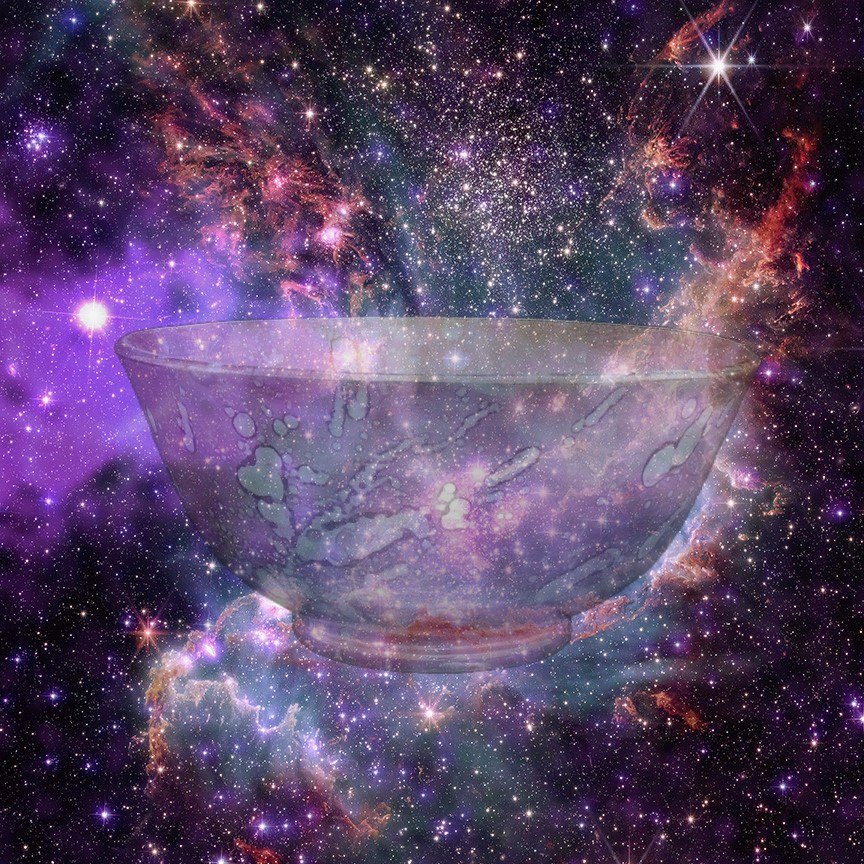
Along with the seeming tools and obscure readouts, one other thing lay on the counter. A translucent bowl rested on the last fold of cloth, a handspan in diameter, patterned with fine veins of pink and flecks of mica. I don’t usually deal in art or fine housewares or looted relics … usually.
“This is pretty, but what would I do with it?”
“If you tell your friends about the fine selection of merchandise in this customer‑friendly establishment, you may have it with two additional purchases of equal value.”
I bought all five of the peculiar tools and took the bowl in the bargain. I know an equipment dealer who sells antique and exotic tools as a sideline, and I was confident he could dispose of them at a good profit for both of us. And the bowl, what would I do with it?
With no plan yet for selling it, I put the pearlescent dish on a shelf at the albergo, set my wrist key in it, and went to take a shower before dinner. When the booth switched from mist to dry, a notice tone cut through the noise of the blower. But when I went to look, the bowl was empty and tilted to one side. I lifted it, exposing my key. The message was from Raina saying she would be a little late but to order her a drink. Standing a moment in puzzlement, I returned the bowl to the shelf.
That night my key kept giving me trouble. The next day I heard my associate had been found partially stuffed into a recycling shoot.
#
Some people suffer from an inability to let go of financial setbacks or perceived wrongs to their pride or the notion their life won’t be complete until mine has ended. But commerce requires activity, so it’s not always easy to know when to be scarce.
My associate and I had, in the past, facilitated exchanges between a variety of parties with various desires. The last time we met, we discussed a venture that might allow certain Eridanians to pursue a culturally specific practice involving the addition of an ingredient to foods and beverages. Many Eridanians believe this substance promotes improved mood and well‑being, but Administration has a somewhat divergent opinion on the advisability of Eridanians ingesting it in any form.
Admin’s position is defensible in that this substance, while linked to the sensation of well‑being, also accelerates Eridani molting and its attendant irritability. It’s been claimed some individuals become so agitated as to cause unfortunate encounters with citizens “minding my own business,” with nightclub patrons who “don’t want trouble,” and even with representatives of station security using “a reasonable amount of force.” Admin contends this justifies prohibiting the substance anywhere within its purview.
It could’ve been in furtherance of this undertaking that my associate unexpectedly entered the waste stream, but it was more likely he met his fate for reasons wholly unrelated to me. I decided to take precautions, but my apprehension was of an everyday sort and moderate in range. When I returned to the Struven shop, I became concerned in a less abstract way.
A police seal secured the door, and a few discrete questions at a nearby bodega produced rumors of damaged echinoderms and a man with a pulse pistol and a range of uncivilized behaviors. I left perplexed. Were my associate’s death and the attack on this shop a coincidence, or had I stepped in something?
I decided to call my tool guy. He said he’d already sold the tools, or whatever they were. “The buyer wanted to know where I got them. He quizzed me and quizzed me. It was almost comical. I finally had to admit I had no idea where my contact acquired them to make him go away.”
Trying to keep worry from my voice, I said, “What did he look like?”
“Oh no you don’t,” he laughed. “You won’t cut me out and sell directly.”
Was this buyer the man with bad manners and a gun? Would he try to find his seller’s contact? In that it was me, I hoped not. The next couple days were normal enough, but then information came to my attention I wish hadn’t been necessary to share. A stranger with dark hair and dark eyes was asking around for me by name. What was my situation? I’d already unloaded the queer tools. The shop where I purchased them had doubtlessly been searched. All I had was the pretty bowl.
Figuring it was probably as safe as anywhere, I went to the rented room. I undressed and again set my wrist key into the bowl, staring at it with newfound suspicion, as though it were the bowl’s fault I was in trouble. Had the man broken in and put my key under it? Was he telling me he could strike whenever he chose to? Wouldn’t he simply have stolen it?
My key’s display lit up, Link Failed blinking on it’s face. The chronograph still worked, but when I compared it to the room’s commscreen the two disagreed by nearly an hour. I didn’t have time for this. There was too much coming at me right now to have a tech test my malfunctioning key. Resetting it manually reconnected the link. Anyway, no time for it.
After showering I wrapped the bowl in a shirt and stuffed it into my bag. If the dark‑haired man wanted things from the Struven shop, it might provide leverage in dealing with him. As it was, though, I barely made it out the door.
A pulse gun emits a focused wave of energy that can knock you out. At close enough range, it can kill. Bag on my shoulder, I exited the hotel, hearing the latch click shut behind me. Then I was on the deck. Stunned but aware, I rolled, pushed myself to my feet, and stumbled toward foot traffic on the plaza. As I approached a food court, I once more felt a shock and slammed to the floor.
On hands and knees, crawling from table to table, a number of customers surprised by my chosen route, I reached a side hall. Shouts erupting behind me, I hazarded a look back. People scrambled away from him, some with keys to their mouths reporting alarm or held up to record. He was taking a big chance acting openly with the weapon, either desperate or simply unconcerned. Short and stylishly dressed, straight brown hair longer than practical in low‑G, this must be the man I’d been hearing about.
I hurried on to the next hubtram depot and a ferry out to the pods, where hiding is a regular pastime for a significant percentage of the populace.
Located at the center of the torus, the port is both gateway to the stars and hopping off point for the pods. The inbound tram halted, and I exited grouped with other passengers. But he’d anticipated me somehow. I spotted him loitering near the portal of a lounge with a good view of the concourse, sipping vending machine tea from a straw. What were my choices? He’d already traced me in the station. What option did I have left but the labyrinth of refitted vehicles and my contacts there?
Ducking into an alcove leading to the commercial docks, I headed for the customs office and a cargo inspector who owed me a favor. When I found him, he was glad to be rid of it. At an airlock, he helped me don a pressure suit, activated a maintenance sled, and began cycling the lock. Given time to prepare the excursion, I’d have arranged a rendezvous at a secluded smuggler’s hatch. As it was I aimed for one of the terminals, exiting in a puff of crystallized vapor.
I’ve looked out the porthole of a shuttle so often I hardly notice anymore, but I’d never seen the view from an exposed sled. Dots of light marking settlements on the darkening globe, we neared our brief night. Its base engulfed by advancing shadow, the Elevator appeared untethered, the Station an escaped balloon trailing its string. Not yet eclipsed, the brightly lit pods hung suspended in blackness, some mad giant’s junk sculpture.
Ditching sled and suit in the unmanned service landing, I gained entry to the terminal but stopped short of the threshold. I didn’t see the man. If he caught me in the pods, he’d have no need to be tidy, and he’d already shown motivation. I hoped I had an advantage here, but I couldn’t be sure of it. He’d cut me off; was he tracking me? Had he infiltrated my key? Admin gear has always been difficult to tamper with, but that didn’t guaranty he hadn’t done it. Had he been in my room at the albergo?
I kicked off the wall, gliding inward. Beyond the terminal a converted Lalandeite freighter connects to an Aquarii lightsail spar. At the end of its long, curving interior, a now‑too‑familiar silhouette neared the lock. How had he gotten in front of me again? Sticking to the bulkhead, where its bend obstructs the sightline, I retreated the way I’d come. I’d make an easy target waiting for the next ferry, and I could no longer access the maintenance bay. So much for not getting pinned down.
I’d passed some storage lockers a couple minutes earlier. Returning to them, I made certain I wasn’t observed, paid with a throw‑away strip, and climbed inside the closet‑sized compartment. The man would either have to continue into the pods or retrace his steps, neither prospect of comfort. Wedged inside the unlit box, my mind stubbornly blank, I tried to come up with a scenario where I wasn’t trapped.
Something hard was poking me in the ribs. Shifting my bag I removed the bundled shirt and unwrapped the bowl, no more than an outline in the gloom, its fine details hidden. My key had gone nuts in the bowl. The first time I put it there, I’d just set the bowl on the shelf. If my key had somehow been on the shelf when I entered the room, I’d have set the bowl on top of it, leaving the bowl tipped to one side. But that’s crazy.
Squinting through a thin slot in the door, motion caught my eye. At the end of the row, he slowly drew closer, inspecting each locker. This was crazy, but I raised the bowl and flipped it over, setting its circular opening onto my head.
#
I’ve tried to work it out logically. If you moved backward in time, would you stay at the same location? If it was an hour ago, I wouldn’t be where I am now, I’d be where I was an hour ago, right? Forget that I’ve been running around, what about the spin of the planet and the progress of its orbit? What about the rotation of the galaxy or the expansion of space itself? Even standing still we’re never where we were a moment ago. Would you have to rewind the entire universe to arrive at the same coordinate?
Squatting in a storage locker, wearing a piece of tableware for a hat, I contemplated my murder. A wave of dizziness replaced embarrassment and dread, and before I passed out, I thought at least when they find my body he’ll have taken it, and the bowl won’t be on my head.
When the lights came on, I pulled myself to the door, scanning the limited field of view. Was he out there hiding? Slipping the bowl into my pack—it wasn’t really a bowl in that sense, I suppose—I glanced at my key’s chronograph. In all the confusion, I couldn’t say what time it should be anyway?
A store near the main entrance sells canisters of pressurized gas and had what I was looking for. Taking position in an intersecting corridor, watching a few commuters rush by, I waited. A figure moved into view, clinging to the opposite wall, pistol in one hand. I’d left the locker door ajar, and he cautiously retracted it, peering inside. Bending my knees, I launched.
He turned as I struck, but the impact knocked him inside the locker. I caught the handle and swung the door shut, feeling the magnetic latch engage as his body rebounded with a thump. Shoving the end of the hose through the slot, I cranked the valve, expansion foam blasting in until it squeezed out of every crack.
No commotion, no charge from the pulse gun, only a muffled, panicky gibberish emanating from somewhere within. Casting aside the empty cylinder, I unlocked the door and pried it open, tufts of hair protruding from near the middle of the yellow mass. The man sputtered and screamed as my fingers neared his face, but I managed to unclog the hardening foam from his nose, clearing his airway.
From my rooms in the Gliese pod, I monitored news feeds and municipal channels. Soon a call came in regarding a person of interest encased in a block of insulation. I felt myself relax for the first time in days. My brain was blurry, but my stomach began growling, and I decided I deserved a reward for being alive.
My broken key wouldn’t connect, so I took a ferry over to the rings, figuring I’d try our favorite café. One of Raina’s friends was there, and I asked if he’d seen her. He acted like he didn’t know me. When I asked again, he got mad and told me to go sleep it off. After being thrown out of the admin dorms, I paid someone for a copy of station personnel rolls. No Raina Oliver in the register.
In the following days, my search found no traces, not in records and not in the memory of anyone but me. She’d said she came from Nivalis province, but I couldn’t locate her there. And what if I did? It seems we never met, and the one place this information remains is in my own head, an isolated effect in a very small region of space.
Years ago when I came up the Elevator, I was too occupied avoiding my downfall to pursue formal education. There is much I don’t understand. Do we inhabit a multiverse, our courses deflected in a bubbling infinity? Are things solid to touch merely shadows cast by potential outcomes? If someone went back in time, if only an hour, could he ever return to where he started?